MoYi Edge Translation
An on-device AI translation runtime for multilingual operations where context, domain terminology, and safety messages matter more than sentence-by-sentence translation.
MoYi (Personalized Edge AI Translation Companion) is positioned as AI translation infrastructure for factories, logistics teams, and multilingual operations: edge-first, privacy-aware, glossary-controlled, and designed to preserve high-priority safety messages without depending entirely on cloud translation.
The latest source code has not been updated yet due to competition and commercial considerations.
- Created a realistic product wedge for enterprise teams: local translation, internal data control, organization-specific terminology, and multilingual workforce training.
- The project is moving toward final/pitching rounds in competitions and programs such as Qualcomm, AI Global, Solution, and related startup tracks.
- Applied to realtime handling of internal meetings with international remote teammates, while moving toward field testing, pitching, and funding conversations.
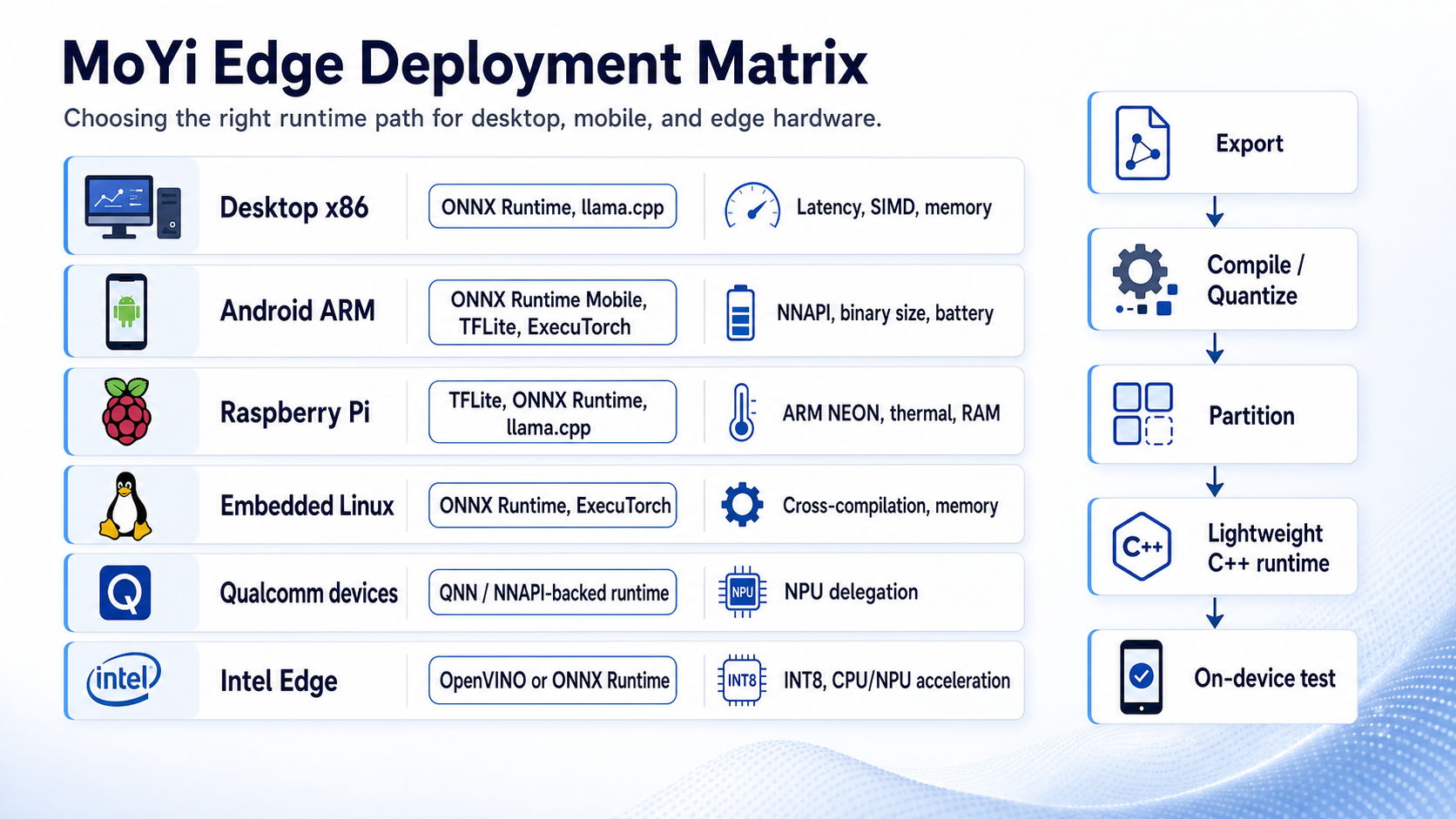
| Device group | Runtime to test | Evaluation focus |
|---|---|---|
| Desktop x86 | ONNX Runtime, llama.cpp | Latency, SIMD, memory |
| Android ARM | ONNX Runtime Mobile, TFLite, ExecuTorch | NNAPI, binary size, battery |
| Raspberry Pi | TFLite, ONNX Runtime, llama.cpp | ARM NEON, thermal, RAM |
| Embedded Linux | ONNX Runtime, ExecuTorch | Cross-compilation, memory |
| Qualcomm devices | QNN/NNAPI-backed runtime | NPU delegation |
| Intel Edge | OpenVINO or ONNX Runtime | INT8, CPU/NPU acceleration |
ExecuTorch uses an export, compile/quantize/partition flow and runs models through a lightweight C++ runtime on device; ONNX Runtime Mobile also supports reducing model and runtime size for mobile deployment.
Project Highlights
Designed for edge deployment to reduce cloud dependency and keep sensitive operational data on device.
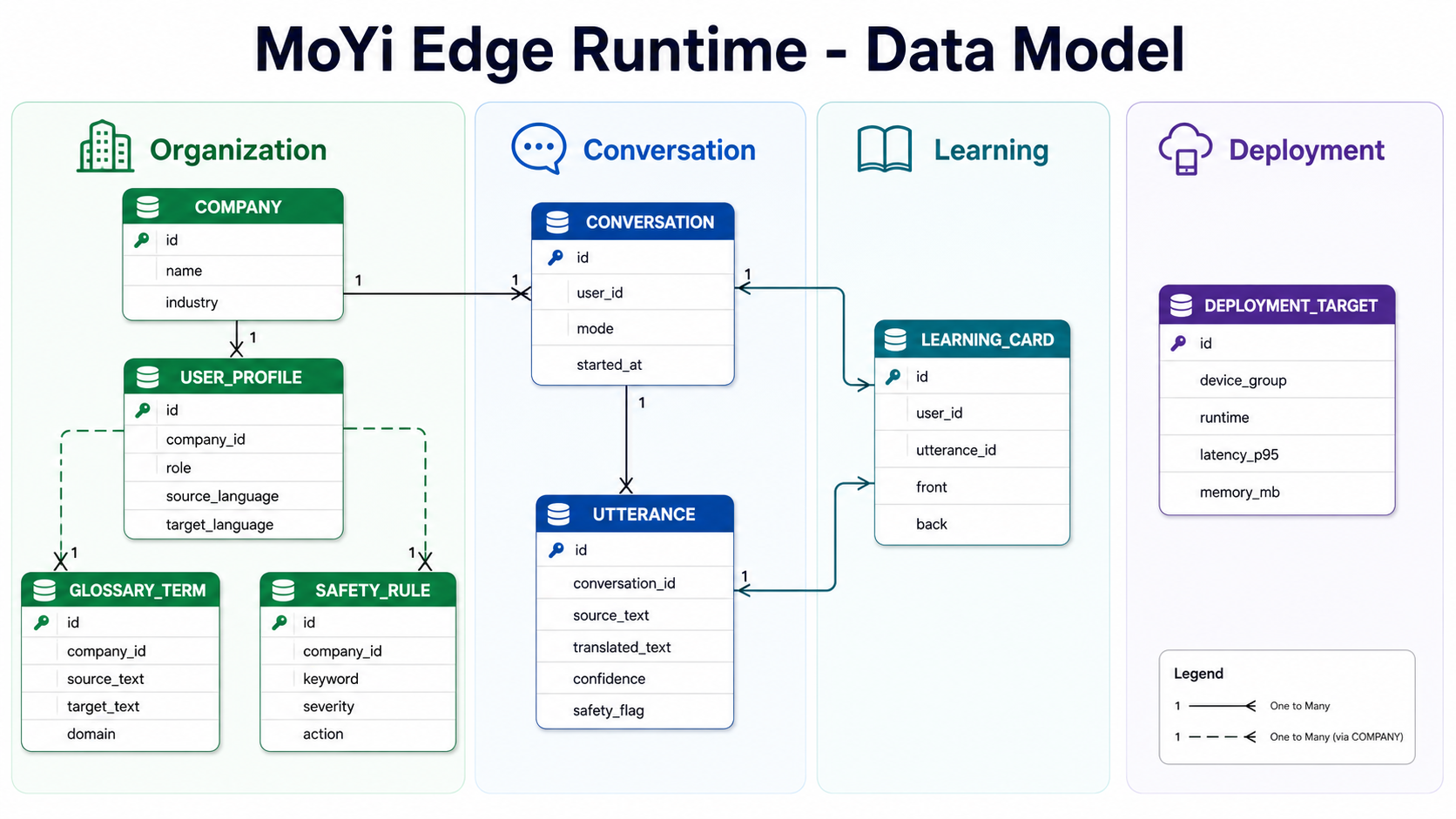
Preserves machine names, workflow terms, technical phrases, and organization-specific language.
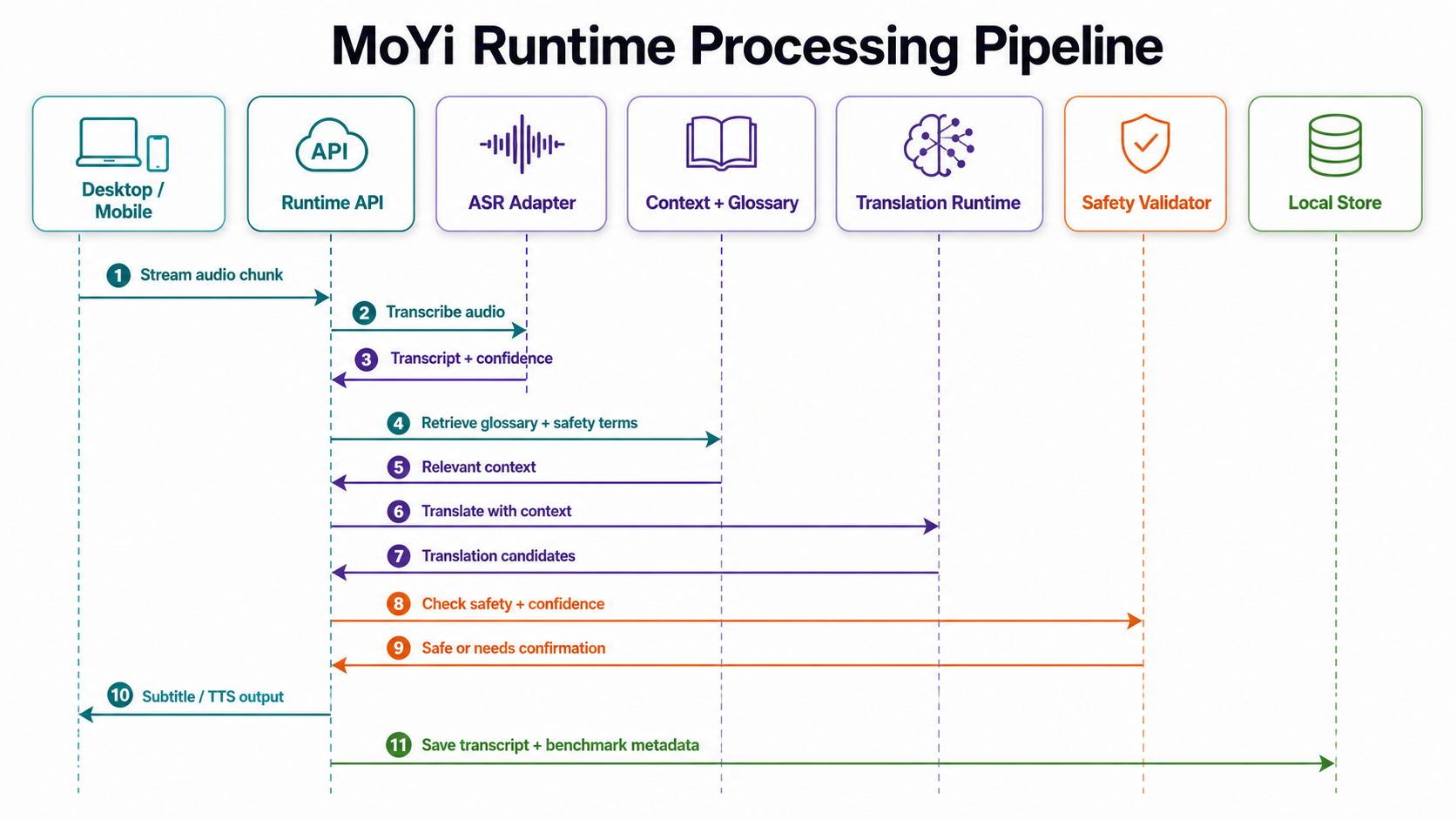
Separates warning, command, and high-priority phrase handling from ordinary translation flow.
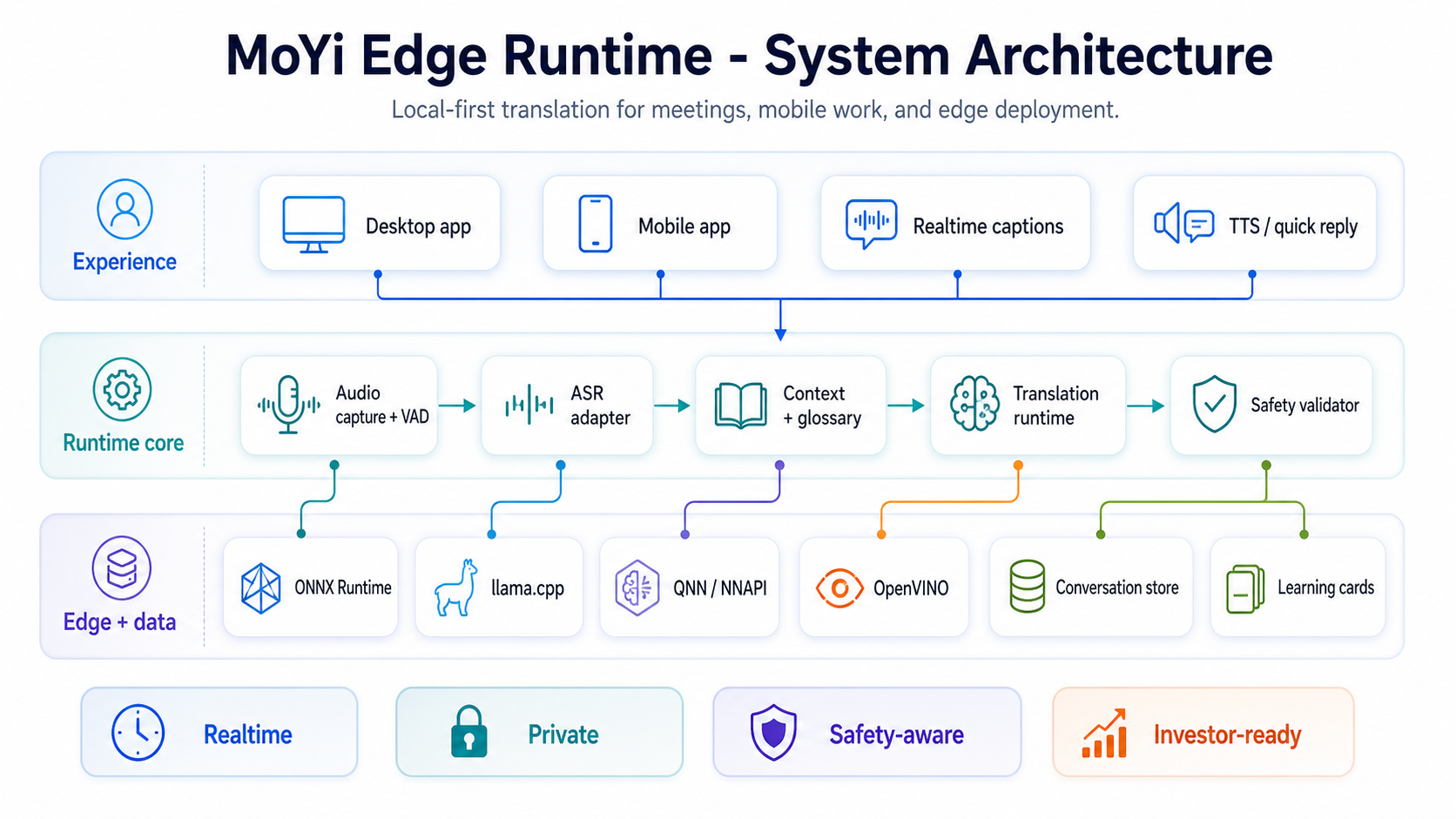
A C++20 core and backend-agnostic architecture let the same workflow run across multiple inference backends.
Video & Walkthrough
Timeline
Behind The Project
Started from real pain
In factories and logistics operations, context mistakes can slow a shift, weaken training, or strip urgency from safety-critical messages.
Product wedge
MoYi starts as a local translation runtime, but can expand into a glossary system, training assistant, and workflow layer for multilingual teams.
Technical moat
The value is not a translation UI; it is the runtime core, context policy, glossary constraints, safety validation, and ability to swap inference backends by device.
Measuring impact
The next validation layer should track P50/P95 latency, peak RAM, model/runtime size, glossary accuracy, safety phrase recall, and quality per language pair.
Gallery
Related writing
Interested in this project?
Let's build practical edge and AI systems for your workflow.