DotX Aero
Local AI smart-home voice assistant and IoT control system running across server, MQTT and ESP32 device layers.
DotX Aero is a local-first smart-home voice assistant and IoT control architecture. It combines wake-word detection, Vietnamese STT/TTS, local Ollama reasoning, MQTT, ESP32 firmware and device execution, and became a foundation for the Gardon smart-garden platform.
Archival Notice: This project was developed about 2 years ago and is currently inactive. Current updates are solely for archival purposes. The technologies used may be outdated, and this repository is intended as a reference only.
Gardon expands this smart-home/IoT foundation into a fuller smart-garden product system.
Project Highlights
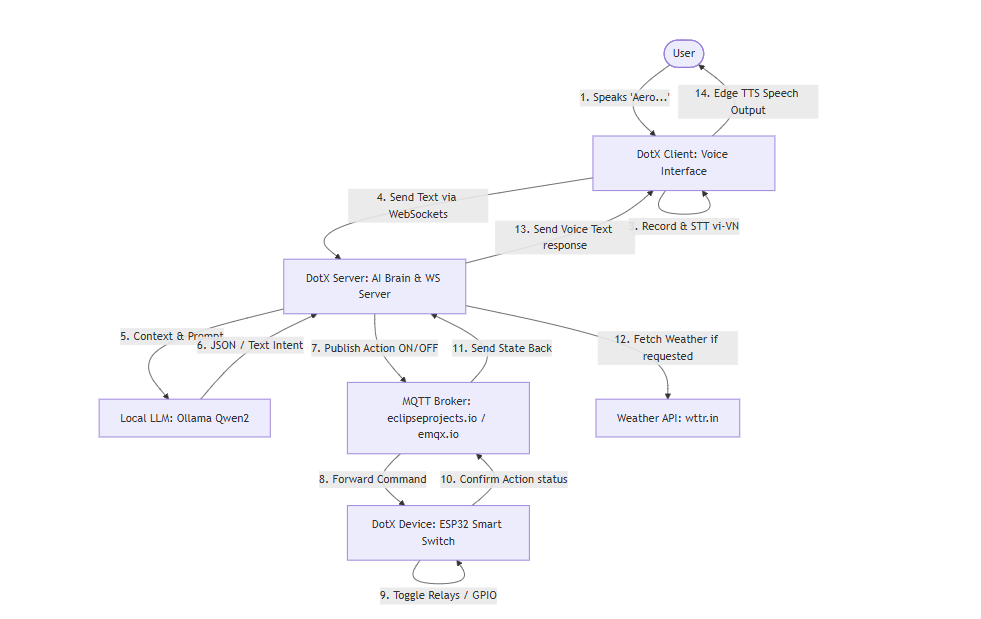
Local voice assistant, AI server, MQTT and ESP32 device execution layers.
Video & Walkthrough
Timeline
Behind The Project
Overview
The system was designed for practical home deployment: a local voice client captures commands, an AI server reasons over intent, and embedded devices execute actions through MQTT.
Problem
Voice-controlled smart home systems can depend heavily on cloud services and fragile integrations. The project explored a local architecture that could understand Vietnamese commands, control physical relays, and keep latency low on consumer hardware.
Approach
The project studies lightweight embedded architecture, low-latency local AI control, MQTT device routing and firmware patterns that can run on constrained microcontrollers and home networks.
Gallery
Interested in this project?
Let's build practical edge and AI systems for your workflow.